


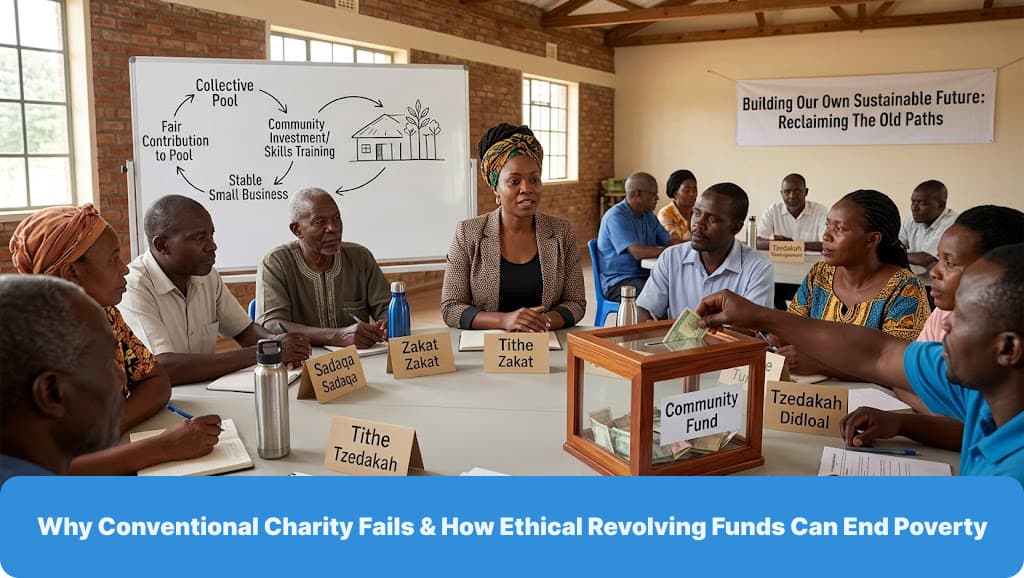
Why Conventional Charity Fails & How Ethical Revolving Funds Can End Poverty
The most powerful tool for ending poverty in Sub-Saharan Africa has been sitting in our midst for over 1,400 years, hidden in plain sight in the collection boxes in our churches, mosques, and temples. But somewhere along the line, we forgot how it was meant to work. Sadaqa, Zakat, tithe, or Tzedakah- whichever way you call it, their underlying principle was the same: to bridge the gap between the poor and the rich, something governments and NGOs have been trying to solve for years now without success.
Charity has been our biggest enemy. Yeah, you read that right. You see, conventional charity is built on a loop: need arises, funds are raised, relief is delivered, need returns. This system saves lives, and it matters, but it is, by design, reactive. And reactive giving, no matter how generous, cannot outpace structural poverty.
And the data confirms what many already feel. Billions of dollars in aid have flowed into Africa over the past three decades. Yet today, over 400 million people across Sub-Saharan Africa still live below the poverty line, according to World Bank metrics. This doesn't mean donors don't care. It’s simply because relief and transformation are not the same thing. This is what we call the charity trap: giving that addresses the symptom while leaving the system untouched.
So here is a more interesting question, one that Zakatek was founded to answer:
What happens when charitable capital is deployed not as relief but as development infrastructure? Instead of asking "how do we give more?" we ask "how do we give differently?" The reality is that we cannot expect different results by doing the same things.
Surprisingly, this is not a new idea. Across the world's great faith traditions, the architecture for transformative giving has always existed. We simply stopped building with it.
Islam: The Architecture Was Always in the Text
The Quran does not describe Zakat as an act of generosity or a vague call to kindness. It describes it as an obligation of purification and names its recipients with precise legal specificity. In Surah At-Tawbah (9:60), Allah enumerates eight categories of those entitled to Zakat: the poor, the destitute, those employed to administer it, those whose hearts are to be reconciled, those in bondage, the debt-burdened, those in the way of Allah, and the stranded traveller. This is a redistribution framework.
The Prophet ﷺ made the economic intent even clearer. When he sent Muadh ibn Jabal to Yemen as governor, his instruction was direct: "It is taken from their rich and given back to their poor." (Sahih al-Bukhari 1395). He was not describing almsgiving. He was describing a transfer mechanism — wealth circulating within the community to level the floor, and not decorate it.
The Prophet ﷺ also warned, with striking foresight, about what happens when this system fails: "Zakat is not withheld from a people except that rain is withheld from the sky." (Sunan Ibn Majah 4019). Poverty, in prophetic understanding, is not only a social failure. It is a consequence of a broken giving system.
The Waqf, the Islamic endowment, operationalised these principles at scale. Historical analyses, such as those published in the Journal of Economic History, demonstrate that at the height of the Ottoman Empire, Waqf institutions financed up to a third of all public infrastructure: hospitals, universities, water systems, and trade routes. The endowment model meant the principal was never spent — only the yield. The asset kept giving indefinitely.
But perhaps the most striking data point in Islamic history belongs to the reign of Umar ibn Abdulaziz (717–720 CE), the Umayyad caliph widely regarded as one of the most just rulers in Islamic history. During his four-year reign, Zakat was distributed with such structural precision that his governors in North Africa wrote back reporting they could find no eligible recipients. Not because the poor had been forgotten — but because the poor had been elevated. In four years. Through one instrument: disciplined, intentional Zakat.

Christianity: Giving as Economic Justice
The Christian tradition of transformative philanthropy begins not with institutional charity but with Jesus himself. In Luke 19, Jesus encounters Zacchaeus, a wealthy and widely despised tax collector in Jericho. The encounter does not end with a sermon about generosity. It ends with Zacchaeus standing and declaring: "Look, Lord! Here and now I give half of my possessions to the poor, and if I have cheated anybody out of anything, I will pay back four times the amount." Jesus responds not by praising his piety, but by declaring: "Today salvation has come to this house." The restoration of economic justice, restitution and redistribution is presented as the outward mark of genuine transformation.
Earlier, in the Sermon on the Mount (Matthew 6), Jesus frames giving with remarkable psychological precision: give in secret, without the left hand knowing what the right hand does. The instruction is not merely about humility; it is about giving that is structurally uncorrupted, not driven by social performance or expectation of return.
The early Church in Acts 2 and 4 took this further, describing communities where "there was no needy person among them", not through individual charity, but through collective pooling and redistribution guided by shared faith.
Centuries later, John Wesley, founder of Methodism, articulated one of the most durable frameworks for faith-based wealth creation in his famous sermon, The Use of Money: "Earn all you can, save all you can, give all you can." The Methodist movement became one of the earliest engines of working-class economic empowerment in 18th-century Britain, funding schools, credit societies, and micro-enterprises for the poor. And the tithe 10% of income was never merely a collection plate donation. In the Deuteronomic framework (14:28–29), every third year the tithe was redirected entirely to the widow, the orphan, and the stranger a welfare cycle, written into religious law.
Judaism: The Highest Charity Makes Itself Unnecessary
In Jewish law, Tzedakah, often translated as charity but more precisely meaning justice or righteousness, carries the same structural logic. Maimonides, the 12th-century philosopher and jurist, ranked forms of giving in his famous Eight Levels of Tzedakah, placing at the very top not the largest donation, but the one that makes the recipient self-sufficient: a loan, a partnership, a job, or a gift of capital that enables someone to stand without support. The highest form of charity, in Jewish jurisprudence, is the one that makes itself unnecessary.
Across these three traditions different theologies, different geographies, different centuries the conclusion is the same: giving was always meant to build, not just relieve.
How an Ethical Financial Pool Actually Works: The Zakatek Model
Understanding the principle is one thing. The harder question is mechanical: how, exactly, does charitable money become economic sustainability?
The answer is a revolving fund, and it is simpler and more powerful than it sounds.
Here is how it works at Zakatek:
Donors contribute Sadaqah to a managed ethical pool. Unlike a conventional charity model where donations are disbursed and gone, the Zakatek pool is structured so that a significant portion is deployed as productive capital, not consumed, but invested.
That capital enters a community in one of several forms: a small enterprise grant to a micro-business, a beekeeping cooperative start-up kit in Yumbe, a sewing workshop in Mombasa, or a trade stock loan to a market vendor. The recipient receives not a handout but a productive asset or working capital something that generates income.
As the enterprise earns, a portion of those returns flows back into the pool not as repayment in the conventional loan sense, but as a community contribution, a re-giving back into the system that elevated them. That contribution then funds the next family. And the next. The principle is never destroyed. The fund revolves.
This is the Waqf principle, modernised. Contemporary research from the Islamic Economic Studies journal confirms that integrating micro-equity with traditional sadaqah structures yields higher long-term self-sufficiency rates than cash handouts alone the endowment yields. The yield transforms while the asset remains.
Over time, what begins as a Zakat obligation becomes a community development engine, each cycle of deployment creating more economically stable households, each stable household reducing demand on the charitable pool, and each reduction in demand expanding the pool's capacity to reach the next family.
The Prophet ﷺ described the ideal of giving using the image of a hand: "The upper hand is better than the lower hand." (Sahih al-Bukhari 1429). The goal of Islamic giving has always been to move people from the lower hand to the upper hand, from receiving to giving, from dependency to agency. The revolving fund is simply the infrastructure that makes that movement possible at scale.
Back to Your Question
Can charity create financial and economic sustainability in low-income families?
Not as charity alone. But as philanthropy with disciplined architecture, tradition-rooted, revolving rather than depleting the evidence across centuries and across faiths says: yes.
The model and resources exist, while the obligation never left.
What's needed now is the will to build systems worthy of the vision.
JUMA JUMA